Sunday, 10 July 2011

2011 Scion tC

2011 Scion tC


What happens when a car spends six years on the market without any major updates? In most cases, sales start to free-fall. In the case of the Scion tC, which has essentially been unchanged since its debut in 2004, that fall has been precipitous. Sales peaked at around 80,000 units in 2006 and then plummeted to 18,000 in 2009. It's time for a change, and Scion is hoping the new 2011 Scion tC it's showing off at New York will help turn those sales frowns around.
Arriving in dealer showrooms this fall, the new 2011 tC features more-aggressive sheetmetal with a tinge of R34 Nissan Skyline to it. The updated interior is highlighted by a flat-bottom three-spoke steering wheel, bolstered front seats and an inward-facing instrument panel, gauge cluster, and center console. A 60/40 split folding rear seat is standard, as is an eight-speaker audio system with steering-wheel mounted controls and the tC's famous panoramic moonroof.
The 2011 tC is also getting a revamp of the unseen mechanical bits. The 2.4-liter four-banger is being swapped out for a new 2.5-liter unit that puts out 180 horsepower and 173 pound-feet of torque, increases of 18 and 11, respectively. Sending power to the front wheels are a pair of new gearboxes. The existing tC's five-speed manual and ancient four-speed auto are both exiting the building to make way for new six-speed units. There are also slightly larger discs on all four corners to improve stopping power.
Exterior diif these updates going to be enough to revive the sagging tC nameplate to its former glory as Scion's best-selling model, but it should certainly give it a fresh lease on life in the notoriously fickle coupe market.


 2011 Scion tC


2011 Scion tC

2011 Scion iQ

2011 Scion iQ


When Scion unveiled its tricked-out, Toyota iQ-based microcar concept at last year's New York auto show, executives insisted it was there to test America's appetite for ultra-small commuter vehicles. Apparently we're hungry for tiny transportation, as the automaker is using this year's show to publically unveil the 2011 Scion iQ.
Like last year's show car, the production iQ is largely a rebadged version of the Toyota microcar of the same name. From what we can tell, attempts to "Scion-ify" the car are limited to smoked headlamps, large Scion emblems, and horizontal grille inserts. The flared body kit and massive 18-inch wheels of the concept aren't carried into production, but knowing Scion, we wouldn't be surprised if similar parts will eventually be pitched to style-conscious buyers as dealer-installed accessories.
First launched abroad in 2008, the miniscule iQ is dwarfed by even the subcompact Yaris three-door. At 120.1-inches long, 66.1-inches wide, and 59.1 inches tall, the iQ is roughly the same size as a Smart ForTwo -- yet its packaging couldn't be more different.
While the ForTwo's engine and transaxle are placed behind the driver and front passenger, Toyota placed the iQ's driveline up front. Although European models are available with two different engines and transmissions, the Scion will be offered only with a 90-horsepower, 1.3-liter inline four-cylinder with variable valve timing. A continuously variable transmission is standard, and will send power to the front wheels.
Packing that equipment in the iQ's nose allows for an entirely different interior layout. Toyota manages to squeeze in a rear seat, generating some additional versatility. By staggering the front bucket seats, the iQ's "3+1" seating allows room for an extra adult in back, along with a child or extra cargo. The rear seatback is split 50/50, and folds entirely flat.
We expect Scion to only offer one trim level on the iQ, but it should still have a decent array of standard features. No doubt in an effort to blunt the inevitable small cars are unsafe chatter, the iQ will be chock full of safety amenities, including ten air bags, stability control, ABS, brake force distribution, and traction control. A six-speaker sound system will be standard, as will a USB and line-level auxiliary audio inputs.
Final pricing and equipment lists have yet to be announced, but Scion expects to deliver the car to showrooms by early 2011.


 2011 Scion iQ


2011 Scion iQ

2011 Porsche Cayenne S Hybrid

2011 Porsche Cayenne S Hybrid


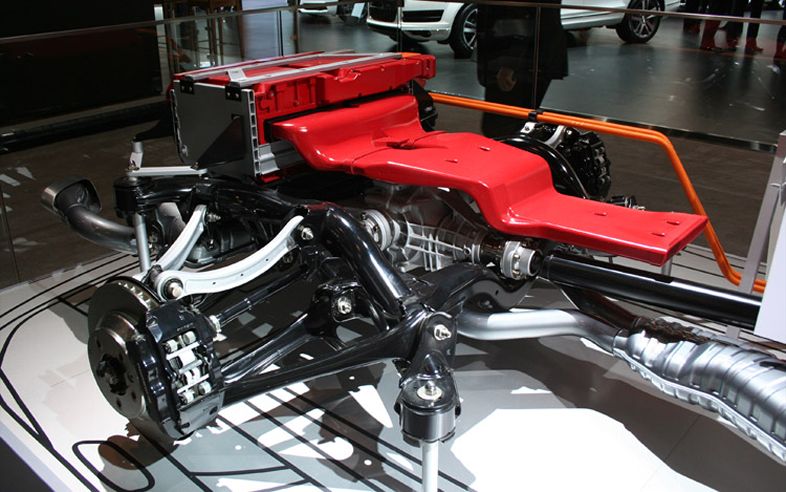
Designed primarily as a way to reduce fleet emissions in the U.S., the Cayenne Hybrid is powered by the same advanced hybrid drivetrain as its platform-mate, the 2011 Volkswagen Touareg Hybrid. That means a 333-horsepower supercharged V-6 from the Audi S4 and a 47-horsepower electric motor can be found underhood, paired by a decoupling clutch to allow each to run independently. Combined, the two power sources make a solid 380 horsepower and 428 pound-feet of torque and run through an eight-speed automatic transmission.
The Cayenne S Hybrid features a 'hybrid controller' system that coordinates the two drive units through the center clutch, enabling the SUV to be driven up to nearly 40 mph on electric power alone. As we mentioned in our First Drive article, the Cayenne S Hybrid can also coast on the freeway at speeds up to 86 mph using only electric power. The Porsche's infotainment display monitors power usage and alerts the driver as to which mode the Cayenne is running in -- combined gas/electric, or one of those two alone.


 2011 Porsche Cayenne S Hybrid
2011 Porsche Cayenne S Hybrid

2011 Nissan Juke

2011 Nissan Juke


eneva coverage, you already know that the Juke is a uniquely styled vehicle, to say the least. Nissan deliberately went funky with the styling to make it a standout in the ever-crowding compact crossover market, drawing cues from rally cars to emphasize the Juke's sporting pretentions. If you were hoping the Juke would look different by the time it showed up at your local dealer, we're sorry to disappoint. The U.S.-spec vehicle will be virtually identical to its Euro-spec twin. Lending the most credence to the Juke's sportiness is its drivetrain. A new 1.6-liter direct-injected and turbocharged four-cylinder makes its North American debut in the Juke producing "180-plus horsepower and 170-plus pound-feet of torque," according to the automaker. We hope to have exact numbers closer to the Juke's on-sale date. Regardless, the engine is mounted to Nissan's Continuously Variable Transmission as standard equipment, though if you skip the S trim level and move up to the SV or SL trims, you can get a six-speed manual.
Unfortunately, the manual transmission is only offered with front-wheel drive. If you want Nissan's impressive torque-vectoring all-wheel drive system, it's CVT only. Despite that, Nissan's AWD system is an impressive piece. Using technology developed on the previous-generation GT-R, the system can send up to 50 percent of the power to the rear wheels and can distribute power from side to side on the rear axle as the computer sees fit to maximize stability and handling.
Opting for the impressive AWD system means you get a multi-link suspension setup in the rear. Stick with FWD, though, and you get a torsion beam, though you do pick up some under-floor storage in the cargo area. Either way you slice it, you get a MacPherson Strut front suspension and 17-inch wheels with all-season tires all the way around.
Built on Nissan's Global B-Car Platform, the Juke will be among the smallest offerings in its segment. Despite that, it offers a high seating position for a commanding view of the road that's so popular in SUVs and crossovers, along with seating for five. More importantly, the Juke's key interior features have carried over to production. The motorcycle gas tank-inspired center console remains and is even painted, not just colored plastic. Above it, the Integrated Control System (I-CON) also remains. The system assigns two vastly different functions to the same controls depending on what mode you're in. In climate mode, the controls adjust the temperature, fan and other settings. Click it over to drive mode (D-MODE) and the controls re-label themselves and now adjust the vehicle's settings, allowing you to choose between Normal, Sport and Eco settings for the engine, CVT transmission and power steering.
To be class competitive, the Juke comes with a host of standard features. Steering wheel controls, Bluetooth, iPod connections, a six-speaker stereo and 60/40 flat-folding rear seats are all included. Key options include auto headlights, leather, navigation, a back-up camera, moon roof, heated seats, and an upgraded Rockford Fosgate stereo with a sub woofer and optional XM Satellite Radio and USB port.
There's no arguing that the Juke will be a very unique entry when it hits the market. The nothing-else-like-it style and compact size have the potential to be big selling points or major turn-offs depending on the buyer, but on paper, it's a perfect fit. Though it would've been the smallest entry in our recent compact crossover comparison, the Juke has all the specifications necessary to run head-to-head with the pack. Does it deliver in the real world? We'll have to get the gang together again and find out.
2011 Nissan Juke
Base price     $25,000 (MT est)
Vehicle layout     Front-engine, FWD/AWD, 5-pass, 4-door SUV
Engine Engines     1.6L/180-hp (est)/170-lb-ft (est) turbocharged, direct-injected DOHC 16-valve I-4
Transmissions     6-speed manual, continuously variable auto
Curb weight     3500 lbs (MT est)
Wheelbase     99.6 in
Length x width x height     162.4 x 69.5 x 61.8 in
0-60 mph     9.0 sec (MT est)
On sale in U.S.     Fall 2010

 2011 Nissan Juke


 2011 Nissan Juke
2011 Nissan Juke

2011 Mitsubishi Outlander Sport