Tuesday, 12 July 2011

2011 Chevrolet Camaros

2011 Chevrolet Camaros

Chevrolet is matching the 2011 Camaro's natural flash with three eye-catching nearly production-ready variants for the SEMA show, which starts this week.
his year's SEMA show will serve as the launch of Chevrolet's new 2011 Synergy Series Camaro. Remember the bright-green V-6 2010 Camaro Synergy edition? Every year, Chevy will release a new Synergy special-edition Camaro.
The difference for the 2011 car is that you can now choose the V-8 as well as the V-6. Four exterior colors will be offered: Cyber Gray, Victory Red, Summit White, and Black.
What sets the Synergy Camaro apart from an ordinary 2011 Camaro is the exclusive gray interior with red accent stitching. The 2011 Camaro Synergy Series, Chevy says, will provide a mix of exterior and interior accessories not available on other models.
2011 Chevrolet Camaro Synergy Series Rear View
 The Synergy show car will sport 21-inch silver-painted wheels -- optional on the production cars -- and a ground effects package you'll find on the showroom Synergy Camaros. The Pedders lowering kit is a licensed Camaro accessory, but it isn't included in the real Synergy edition. Get your own 2011 Synergy Camaro in the first half of 2011.
With the Red Flash Camaro show car, Chevy's mission was clear: make the Camaro as visually arresting as possible. Gray strips are placed atop the Red Jewel color and, of course, 21-inch wheels fill the wheel wells. A Chevrolet Accessory air intake kit and exhaust kit make clear this Camaro has show and go.
Inside, there's a flat-bottom steering wheel and red LED lighting in the door trim. Power comes from a 6.2-liter V-8 mated to a six-speed manual transmission.
The most affordable of the street-ready Camaros is the unimaginatively named XM/Accessory appearance package.
"Our intent was to create a special, customized model -- including 21-inch wheels -- that could be had for around $30,000," said Russ Clark, director of Chevrolet product marketing.
2011 Chevrolet Camaro Synergy Series Interior
With that in mind, it shouldn't be a surprise that this Camaro is a V-6 model with black cloth seats. A rear spoiler, unique grille, and 21-inch wheels are included in the package, which will be available in production form in the spring of 2011.
One year of XM satellite radio is also part of the deal whereas other Camaros only have a three-month trial period. The XM/Accessory appearance package Camaro you see here also has concept car details you won't see on the production model. That includes a cold air intake system and a Chevrolet Accessory interior trim kit in Silver Ice.
Which, if any, of these three Camaros would you be willing to claim as your own?


 2011 Chevrolet Camaros
 2011 Chevrolet Camaros
2011 Chevrolet Camaros

2011 Chevrolet Camaro Convertible

2011 Chevrolet Camaro Convertible

The new Chevrolet Camaro Convertible has been nearly four years in the making, but today we're one step closer to it becoming a reality. The automaker dropped an official release today detailing the drop-top muscle car in full.
We first laid eyes on a reborn Camaro Convertible at the 2007 Detroit Auto Show, when General Motors teased muscle car fans with a ragtop variant of what was then its latest design concept. Like the coupe, the Camaro Convertible transitioned into production with few major cosmetic revisions. The production car does without the concept's chromed windshield header, slick redline wheels, and enlarged exhaust tips, but is otherwise virtually a line-for-line copy of the earlier show car.
According to GM, a Camaro Convertible was never an afterthought -- the car's structure was reportedly designed from day one to accommodate a topless model, and engineers worked to strengthen the body -- not soften the suspension -- to compensate for the lack of a fixed roof. Camaro Convertible models receive additional structural bracing, including an underhood strut tower brace, a transmission support reinforcement, an underbody tunnel brace, and front and rear underbody V-braces. To help curtail cowl shake, the A-pillars are reinforced with hydroformed tubing, an inner bracket in the header, strengthened front hinge pillars, and reinforced rockers. All this work pays off -- according to GM, the Camaro Convertible offers torsional rigidity eclipsing that of a BMW 3 Series convertible.
Arguably, engineers had their work cut out for them when it came time to working out the top mechanism -- something designers never fretted over when penning the show car. GM worked to replace conventional aluminum bows and knuckles with composite parts to help retain the coupe's roofline. The power top reportedly stows and deploys in 20 seconds, and is latched via a single, center-mounted handle.
Predictably, a power top mechanism, coupled with the requisite reinforcements, adds roughly 276 pounds to the Camaro's curb weight, but output from both engine offerings remains unchanged. Six-cylinder cars continue to utilize GM's 312-horsepower V-6, while Camaro SS models are fitted with GM's 426-horsepower, 6.2-liter LS3 V-8. Both engines are available with either a six-speed automatic or a six-speed manual transmission, but SS cars fitted with the auto will lose 26 horsepower and 10 pound-feet of torque.
Although Camaro coupes are offered in an entry-level LS trim, Camaro Convertibles will only be offered in LT and SS forms. According to GM, an entry-level 1LT convertible stickers at $30,000 (including $850 in destination fees), signifying a $5270 premium over a comparable LT coupe. Pricing for SS models hasn't been announced, but it's expected a V-8 convertible will likely sticker in the neighborhood of $37,000.
We'll know for certain in a few months. Production of the 2011 Camaro Convertible will begin at GM's facility in Oshawa, Ontario, Canada early next year, and early production cars should reach dealers by February.


 2011 Chevrolet Camaro Convertible

2011 Chevrolet Camaro Convertible

2011 BMW X3

2011 BMW X3

Talk about déjà vu. Two years after rolling out Chevy's Orlando concept en Paris, General Motors will unveil the production-ready 2011 Chevrolet Orlando crossover this September at the 2010 Paris Motor Show.
Overall, the Orlando concept morphed into the production 2011 Orlando with few changes. The largest departure from the original show car lies at the nose, where the angular, chiseled lines of the original design were replaced with a softened snout. The angular, trapezoidal headlamps are gone, replaced with large, rounded assemblies that help flow into the front bumper's sweeping upper edge. In back, the narrow tail lamps grow to incorporate white turn signal lenses, while a lamp combining the fog tail lamp and back-up light is placed in the middle of the rear bumper fascia.
GM has yet to release photos of the production-spec interior, but we're not expecting a big break from the concept, which sported a rounded, dual-cockpit dashboard that gently flowed into the center stack, along with seating for seven spread across three rows. Interestingly, one conceptual cue -- a cubby and USB audio input hidden behind the front fascia of the audio system -- is reportedly making its way into production, and we wouldn't be surprised if the fold-flat nature of both the second- and third-row benches also becomes reality.
2011 Chevrolet Orlando Rear View
The 2011 Orlando rides upon a stretched version of GM's front-wheel-drive global small car architecture, which also underpins the likes of the 2011 Cruze and the 2011 Volt plug-in hybrid. Buyers will have their choice of three different engines, including a 141-horsepower, 1.8-liter gasoline I-4, or a 2.0-liter turbo-diesel I-4 offered in both 131- and 163-horsepower forms. Transmissions choices will likely include six-speed automatic and manual options.
What's all this? Diesels and a manual? Yes, and if that doesn't tell you what markets the Orlando is targeting (hint: they're all in Europe), we don't know what will. GM had once pledged to sell (and build) the Orlando here in the United States, but apparently reversed course and proclaimed it to be a "global" offering that won't make it to North America. Still, we've heard some executives are pondering adding a small van to Chevrolet's U.S. portfolio.


 2011 BMW X3

 2011 BMW X3
2011 BMW X3

2011 Audi R8 GT

2011 Audi R8 GT

These days, it's seemingly a requirement for any supercar worth its Y-rated rubber to have a limited-edition evil twin. Names like Scuderia, Superleggera, GT3 RS, and ACR-X are all testament to the current demand for no-nonsense road monsters, sacrificing comfort and practicality for purpose and sheer speed. Audi's R8 was billed as an everyday supercar when it was released, and the addition of a V-10 in the latest example hasn't done anything to change that impression. But such a reputation is a double-edged sword, with some dismissing the mid-engined Audi as too soft, or without soul.
Audi R8 GT Rear Three Quarter
Fewer people will be saying that about the Audi R8 GT, but mind you, this is still no anorexic skin-and-Kate Moss. Consider that Audi's quattro all-wheel drive system is retained, as is the stereo and climate control system. There are no Spartan nylon door pulls or bare aluminum floor panels to be found, and the R8 GT retains the majority of its sound insulation. For the most part, the R8 GT's diet consists of lighter materials -- no easy task when the standard car already boasts an aluminum space frame and magnesium chassis.
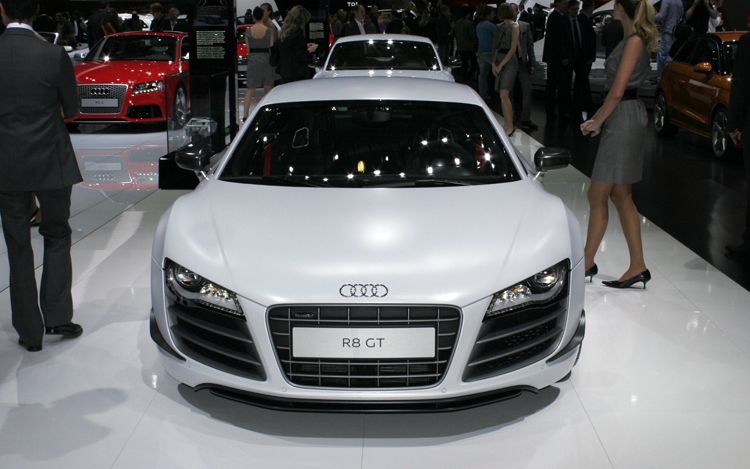
Audi R8 GT Front
Still, engineers set to work using thinner glass for the windscreen and polycarbonate for the rear window and engine cover, saving 20 pounds. The R8 GT's sheetmetal is of a lighter gauge and cutouts were made to the aluminum luggage hatch, while the rear hatch was remolded in carbon fiber-reinforced plastic, along with the car's trademark sideblades and rear bumper -- another 35 pounds lost. Weight was also removed from the power brake system, battery, air intake module, engine compartment insulation, and exhaust system. Inside, glass-reinforced plastic helps lighten the seats (69 pounds saved), while the carpet is slightly thinner and lighter for an additional 17 pounds gone. Combined with other weight-saving measures, a hair over 220 pounds was shaved off the R8 V10, bringing total curb weight down to 3362 pounds.


 2011 Audi R8 GT
 2011 Audi R8 GT
2011 Audi R8 GT

2011 Acura TSX

2011 Acura TSX

The exterior of the 2011 Chrysler 200 attempts to pull away from its Sebring predecessor. The sedan features a bigger grille is bigger and projector-style headlights that give the front a new angle, while the rear features a sleeker look with slimmer taillights and a fresh rear fascia. Even the Chrysler badging has taken a new direction. The 200 also has LEDs everywhere in an attempt to give it more class than the outgoing Sebring. LED taillights are joined by an LED high-mounted brakelight. In front, the 200 joins the LED light pipe party, with some LEDs around the headlights for extra style.
Sitting beneath the hood is the 3.6-liter Pentastar V-6 or the base 2.4-liter inline-four. An old-school four-speed automatic transmission will be offered at the lower end of the lineup, but a six-speed auto will otherwise be standard gear-changing fare.
The $19,995 Chrysler 200 LX may continue to be a rental car special, with its 2.4-liter four-cylinder engine mated to a four-speed automatic. The 200 Touring is $2000 more, but Chrysler is still keeping quiet on what exactly separates the trim levels. Regardless of whether you choose cloth or leather seats, all 200s have a new seat design with more cushion material and revised spring geometry.
The 200 Limited will retail for $24,495, or $1630 more than a 2010 Chrysler Sebring Limited. An S model will arrive later.

 2011 Acura TSX
 2011 Acura TSX
2011 Acura TSX